
SB1720 — Equal Parenting Time The 13th and Final Family Court Reform Bill
Bill 13 of the "13 Bills Killed" by Judiciary Chairman Quang Nguyen

by Shawn Dell Wildman
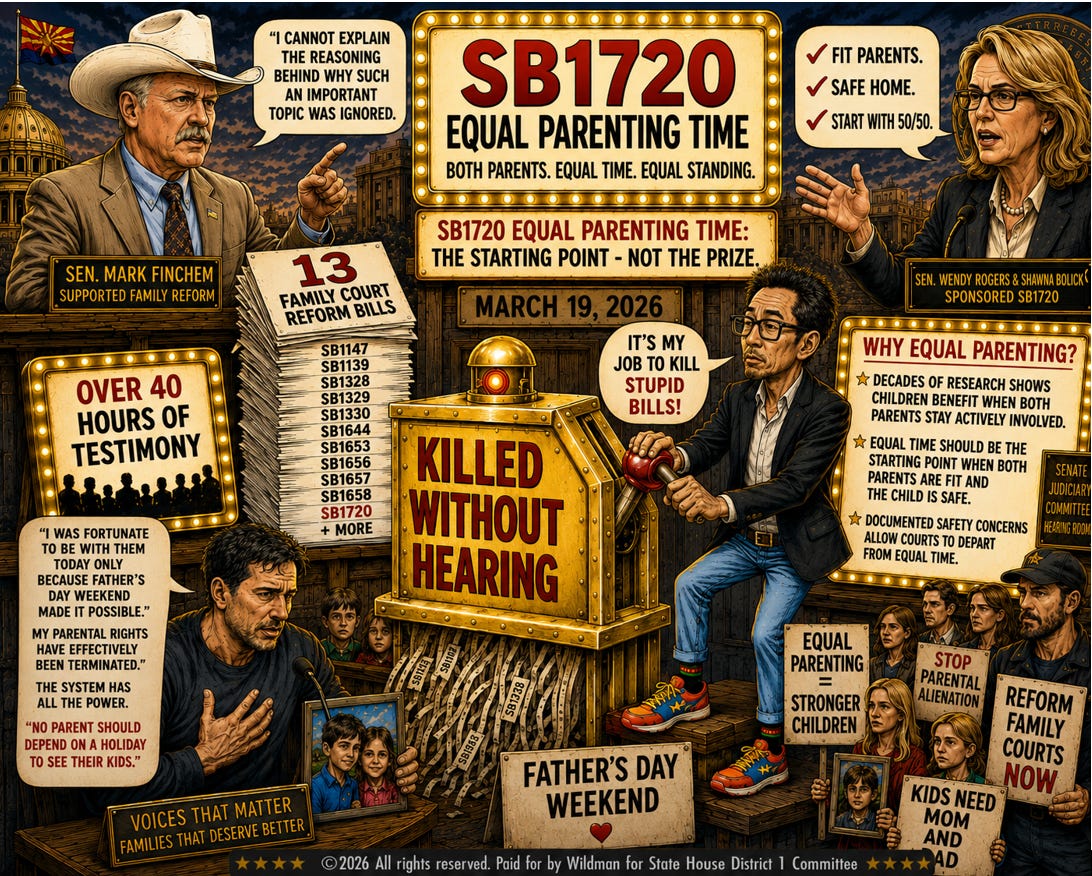
Both parents. Equal time. Equal standing.
That was the simple principle behind Senate Bill 1720.
The bill would have directed Arizona courts to begin with a presumption of equal parenting time when both parents were fit, and the arrangement was safe for the child. Judges could still depart from equal parenting when documented safety concerns existed, but equal time would become the starting point rather than something one parent had to spend years and thousands of dollars fighting to obtain.
Supporters argued that the proposal reflected decades of research showing children generally benefit when both parents remain actively involved in their lives.
Under Arizona’s current system, equal parenting time is not guaranteed. It is often the subject of expensive litigation, competing evaluations, and prolonged court battles. SB1720 sought to change that by shifting the burden. Equal parenting would become the presumption unless a documented reason justified a different arrangement.
Senators Wendy Rogers and Shawnna Bolick sponsored the bill, and Sen. Mark Finchem supported it as part of a broader family court reform package.
One of the most emotional moments during testimony came from ’S’, who appeared before Sen. Finchem’s committee during Father’s Day weekend with his children seated behind him.
According to his testimony, court actions had severely restricted his relationship with his children. He told lawmakers that he was fortunate to be with them that day only because Father’s Day weekend made the visit possible. He described a system in which he believed his parental rights had effectively been terminated and recounted events involving his son that he said demonstrated the power family courts exercise over families.
Supporters argued that no parent should have to depend on a holiday to spend meaningful time with their children.
For them, SB1720 represented a cultural shift. Equal parenting would no longer be treated as a prize awarded after years of litigation. It would become the default starting point whenever both parents were fit and the child’s safety was protected.
But SB1720 never received a hearing.
On March 19, 2026, Chairman Quang Nguyen “killed” SB1720 without a hearing, without a vote, and without a public explanation. That day the bill died alongside twelve other family court reform measures that had been presented to lawmakers after more than forty hours of testimony from Arizona families.
Sen. Finchem later stated:
“I cannot explain the reasoning behind why such an important topic was ignored.”
For supporters, SB1720 became symbolic of a larger debate over the future of Arizona family court. They argued that the issue was not partisan. It was about whether children benefit from meaningful relationships with both parents whenever circumstances safely allow it.
SB1720 was the final bill in a package of thirteen family court reform proposals.
Thirteen bills.
More than forty hours of testimony.
Families who traveled to the Capitol to tell their stories.
And on March 19, 2026, all thirteen bills were held without hearings and died without votes.
Supporters continue to argue that equal parenting time should be the starting point for fit parents and that family court policy should prioritize children’s relationships with both parents whenever doing so is safe and appropriate.
Read the full text of SB1720:
https://www.azleg.gov/legtext/57leg/2R/summary/H.SB1720_031926_JUD.DOCX.htm
Subscribe for free and share this page so you don’t miss a post. Then share this with one person — a parent, a neighbor, anyone who deserves to know what happened and what’s on the ballot July 21st. That’s how this message travels.